
Height
A short or tall seam
Seam height is compared with the can maker's limits around the can. A low spot is not averaged away.
Get started
×Tell us about the line. A person reads it and replies.
Or talk it through first:
30-minute Google Meet call, Monday to Friday, 9 am to 5 pm Pacific.
Need a full study of the line first?
Canning lines
Cameras check the visible double seam on every can after the seamer and reject a can outside the can maker's limits. The check does not replace the plant's seam teardowns.
On every can
The double seam is the can's seal. The cameras measure what shows on the outside of it. This is not a sample. It is the cans that pass the station.
Height
Seam height is compared with the can maker's limits around the can. A low spot is not averaged away.
Shape
A top view checks that the seam is round and centered on the end. An off-center seam is a sign to check the seamer setup.
Outline
A droop, a vee, a sharp seam or cut-over, or a rim dent changes the outline at one spot. The side views see that local change.
Drift
One reject is a bad can. Several in a row point to the seamer, such as a roller or chuck, so maintenance can look before the next teardown. If the line already identifies which seamer head made the can, that identity can be saved with the image. If it does not, the alert is still the run of rejects.
Limits
Inline vision is a screen of the outside of the seam. The plant's seam program still cuts cans open.
Inside the seam
A camera cannot see body hook, cover hook, overlap or tightness. Those are measured by teardown, by a qualified person, on the schedule in the plant's closure program. For low-acid canned foods, that program is the one described in the double seam article, which cites 21 CFR 113.60. The camera does not satisfy that rule by itself.
Reference
The station is set up against a reference can whose seam was measured by teardown, and re-checked against that can at changeover. If the camera and the teardown disagree, the teardown wins.
Other packs
A pouch, flow-wrap or tray seal is a different picture, taken from one side. That job is vision inspection, not this can seam check.
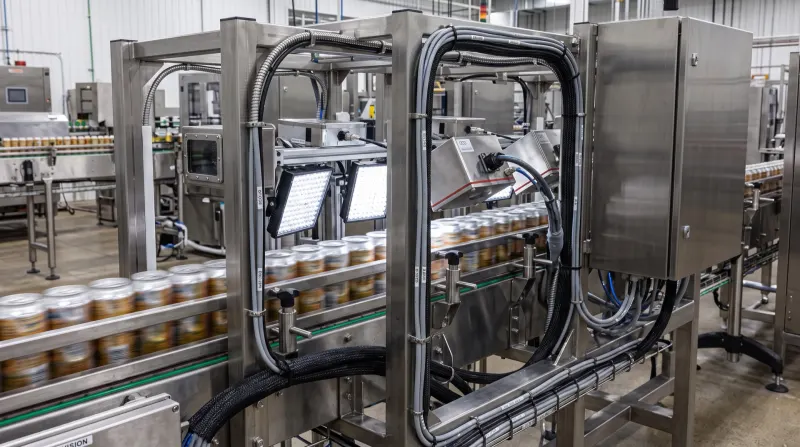
Food cans and beverage cans are both closed with a double seam. On a food line, start with food production lines. On a can line for drinks, start with beverage. The hardware layout is the can seam inspection station. How a station is specified, built and handed over is on how a JM system is delivered, and the full set of stations is on vision inspection stations.
The long explanation of what a camera measured on one canning line, and what it still cannot see, is double seam defects explained.
FAQ
No. A camera sees the outside of the double seam. Body hook, cover hook, overlap and tightness are inside the seam and still need a teardown by a qualified person, on the schedule in the plant's closure program. The station is set up against a torn-down reference can. If the camera and the teardown disagree, the teardown wins.
The visible seam: height around the can, whether the seam is round and centered, and a local outline fault such as a droop, a vee, a sharp seam or cut-over, or a rim dent. A can outside the can maker's limits is rejected. The camera does not see the internal seam dimensions a teardown measures.
The station uses a short, strobed exposure and an encoder so a moving can can be tied to the reject. Whether that holds at the seamer's speed is checked with the plant's sample cans. The study says so in writing before a proposal.
Both close with a double seam, and the visible-seam check is the same kind of measurement. The can maker's limits and the sample cans decide the setup. For low-acid canned foods, scheduled teardowns stay part of the plant's program. Most beverages are not low-acid canned foods.
Include the can maker's seam spec. The assessment says in writing whether a camera can measure that seam on your line, before a proposal. For round cans, the camera choice is covered in line-scan or area-scan.